


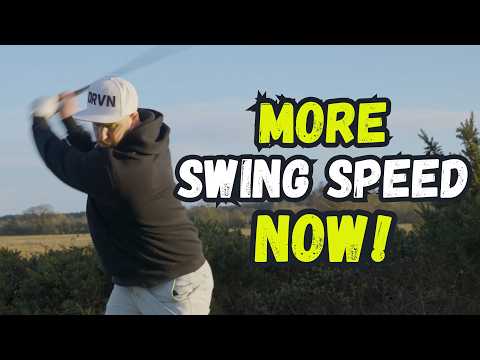
3 Things you MUST do to increase Speed in your Golf Swing
Three overlooked speed factors, starting with stability and durability via the dumbbell rotational chop, to safely gain club head speed.
Transcript
· auto-generatedAs golfers, we all want to increase our club head speed so we can hit longer drives. But you're probably missing out on these three factors, meaning you're not only gaining the speed that you are capable of, you're also putting your game at risk as well. I'm Michael, PGA professional and head of performance here at DRVN Golf and Fitness.
And today we are looking at three key factors for increasing speed in your game that you are probably overlooking. We're going to take you through each. We're going to help you to implement them into your week, your lifestyle, your training.
And wait until the end of the video. We're going to give you a free month of training with our DRVN speed programs that have helped thousands of golfers around the world to see massive, massive gains. So, we're going to get to work.
This is going to help your game. Let's go get it done. Factor number one, stability mixed with durability.
That means that as you get faster, as you can actually move the club faster, your body can handle that force, that speed, and actually deliver it into the ball for consistent ball striking and to resist injury. Because if you're putting more stress on the body, it needs to be able to accept it. Couple of the best moves you can do for this with a dumbbell.
Number one, the rotational chop. One thing you'll notice about a lot of our stability work is that it's asymmetrical. That means one side of the body is doing different to the other.
Very important in your golf swing because of all that rotation. So here with a reasonable dumbbell, midweight really, you're not going too heavy. We get into this split stance position.
We rotate down making sure we fire the core and then lift up and around that lead leg. So as you sit, work around the core, stay dynamic. And from here, we're improving your stability around the spine, but also we're improving your ability to rotate and at weight.
You get more stable and more durable. We're going to pair that with deceleration work. That means, yes, your body can go fast, but also it can slow down.
Key to allowing yourself to access all of the speed available. We're going to use the same dumbbell. This time, we're on the feet.
We're going to move fast, but the key is that stability, being able to slow down with that weight. Again, we're asymmetrical. We got the left foot forwards, weight in the right hand.
First of all, we get really balanced through your center of gravity. Again, just like your swing, we don't want to be heels. We don't want to be forwards.
You want to be really balanced and ready to go. From this movement here, we're going to bring our feet together. Then back to this position, ensuring we do not lose any balance.
That set, that deceleration, how we stay so stable is huge for your game because then you can accept all of those forces so you can create more force as well. And you can see here how this would relate to your game. If you really don't have the balance, if you're not using the ground correctly, if we can't slow down and we lose our stability, our balance, you're in a position of weakness.
You're going to lose all of that force you created and you're not going to be able to apply it. These two are an incredible way to build stability and durability in your swing and they're going to impact everything because asymmetrically we need to be able to load into that trail side going back ensuring that we got really good pressure here and solid posture and then as we bring all of that speed into the ball. If you're not strong and stable enough, you're not going to be able to apply it the way that you want to.
So work on your stability, load your positions, get stronger through the ground for consistency, to reduce injuries, and to imply all of that force into the ball. Factor two is power. You can't have speed without power, and if you do, it's not going to work out well.
Power is the ability to create maximum force in the shortest possible time. Think about that down swing. Once we get to the top, we're changing direction.
That club travels down from the top of the back swing into impact in a fraction of a second. All right, if we're moving fast, it really is going to get there quickly. So, we need to be able to use the ground, create force, create leverage, and apply it to the golf ball.
We want strength through the lower half. That is huge because we can only create power through the ground, and that's how we transfer it. This is one of the best combinations and power training requires consistency over time and a structured plan.
So, we're going to get into it briefly today. We got trap bar deadlifts and loaded dumbbell jumps. Okay, so here we're at submaximal weight.
That is important for power because it's how quickly you move the weight and it's all about positioning. So, just like your golf swing, you want to be fully connected to the ground. We need to set our posture in the best position possible.
Fully set your body and execute. So the key is fast up and slow down. If you can control that eccentric phase, you're really going to help how you develop.
You reset and move fast. Once you move from there, the big muscles are absolutely fired up. You hit your sets, you hit your reps.
Then we go into our contrast element. We're going to move even faster with the dumbbells. And this is how you absolutely drive power through the legs.
We're fired up after the compound lift. We got relatively light dumbbells here. Just increases your body weight.
We're now going to work into the ground, create those reactionary forces, and accelerate with everything that we have. Now, of course, you can do body weightight jumps, you can do box jumps. As long as you are moving your body as fast as possible, you're going to be making progress in terms of your power.
And we already touched on it, but this is how you really do use your lower body and swing, fire the hips first, and transfer it into your game. So, think about when you're set up, we want leverage through the ground. We want that counter pressure where once we turn back, the body wants to work into the ball.
So, we get that pressure shift going back. We load to the top. And as you then transition down, this is where we turn on the power.
We work into your biomechanics. We fire the hips, push out of the ground, and maximize all of the force through the body into the club head. That is power.
The final thing we need is going to tell you how to get it done. But this is a huge part of your training. It's also one of the most fun ways to train.
You're going to feel athletic. You're going to feel fast. You're going to feel powerful.
We've helped you get more stable and more durable. We've improved power output. Now, it's all about training biomchanics.
And basically, that means understanding the patterns required to actually create a better golf swing. That's why we do it in this order because you need to be stable if you want to improve your power. And once you have the power, we need to be able to fire it into our golf swing mechanics if we want to be maximally efficient in terms of turning our training into yards.
So, couple of explosive movements here before we get into that month of training. Number one, and this is advanced, so we have different options working up to this, is the step two swing with a kettle bell. This one here is 12 kilos, 26 lbs.
And this is enough weight for me on this movement. So, you really need to be light here. This is about mechanics, changing direction, and working on how you move throughout the swing.
So, we're going to take our golf posture, and we're going to go into our back swing. With this weight, we're really just loading into that hip, ensuring that we rotate and load the trail glute as you do in your swing. So, we work off the ball and with that step, we're going to exaggerate that feel, step into it, and fire the hips.
Okay? So, in terms of biomechanics, the kinematic sequence, this is enhancing all of your awareness and your force potential in one movement. So, we start in our golf posture.
We go into our back swing. Step, step, go. So we go.
That step really enhances how you open up the hips. So we're fully loaded on our trail leg. We step into our posture.
Fire the hips. And then the speed is what moves the kettle bell. We're not trying to lift the kettle bell here.
That's very difficult. If we use our hips properly, we can fire with so much speed. We get more and more dynamic.
And yes, we always change train both directions. So in working the other side, you're working that counter rotation. You're improving your body's body's mechanics so you can rotate in both directions, creating more speed in your swing.
Exactly the same deal. Start here, load, step, fight. You can see that even though that's the weakest side relative to the golf swing, we're still creating a lot of force rotating through the hips.
Another great way to train speed, our favorite med balls. Okay, we can get super explosive and we really do want to max out as much speed as possible. One of the best step two rotational press.
Okay, so we're starting our posture. We step back to get that load. Very much similar to the kettle bell in terms of our sequencing and our biomechanics.
We then return to the wall, fire the hips first and create that force. So the more explosive you can be, the more you learn how to create that reactionary force through the ground to the target, the better you're going to be. Then we get that upper body release.
That's maximizing your speed potential. [Music] You can see that we're loading up. We're firing the hips.
The core stays stable. And then we create as much power and speed through the upper body as possible. This is how you transfer that power, that speed into your golf swing.
This is how you train in the gym to increase your speed. Let's talk about the swing one more time before we get you that full month of training. So once you have stability, you have power, and you have the biomechanics, then you need to move the golf swing fast.
And that comes down to practice, training, and dedicated speed sessions. All right, speed session can look different for different people. They're very taxing on the body.
So, you need to start with ample rest, lower reps, and build up over time. The thing with DRVN, we do all of this for you. And as we said right at the start of video, we want to give you a full free month of training at this key time of the year.
So, we're still just about in the season. We can help you gain serious yardage as well as improve your all round fitness with the link below. You're going to download our programs, have a look through everything that we have, and with that email address, we will set you up an account, reach out directly, and get you into the DRVN app.
All you have to do is hit the link below to get that free download, and we'll get you set up with the best workouts in golf. All right, so we hope you enjoyed this video. This was an overview of the three things you need if you want to actually create speed right now and that lasts into the future to reach your potential and allow you to golf strong.
More in Speed & Distance
 8:36
8:36Want a Faster Golf Swing? Do this Golf Fitness Session!
 18:48
18:48Bryan Bros Golf Swing Speed Battle!
 6:53
6:53Explosive Exercises to increase Golf Swing Speed
 11:00
11:00Crazy Golf Swing Speed Session with Martin Borgmeier
 9:29
9:2910 Minute Golf Fitness Session to Feel and
 16:52
16:52